

I’ve been writing about simple, lower-impact living here for a long time, and I’ll admit something: travel is the place where my values and my wishlist argue with each other the most.
So when I started looking into Norway, I was braced for the usual thing — a lot of brochure language about “eco-friendly” voyages with no numbers attached. What I found instead genuinely surprised me, in both directions.
The good: Norway had 111 electric car and passenger ferries in service as of August 2026. The world’s first electric car ferry has been crossing the Sognefjord since 2015. In August 2026, 98.7% of new cars sold in Norway were electric — a world record, and they hit it after cutting the subsidies. The train from Oslo to Bergen has been fully electrified since 1964, and about 88% of Norway’s power is hydro. You can take a fully electric boat through a UNESCO World Heritage fjord.
The complicated: Norway pays for a lot of that by selling the rest of us fossil fuels. Oil and gas is around 57% of the country’s total goods exports. And the single biggest piece of my own footprint on a Norway trip wouldn’t be the boat — it’d be the flight to get there.
I’m going to be straight with you about both, because I think that’s more useful than a post that only tells you the nice part.
What I did: compared 20 companies selling Norway to American travelers, checked which ones actually include the airfare, and dug into which sustainability claims hold up when you look for a number behind them. My top pick is Great Value Vacations, with a genuinely close runner-up that might suit you better if certification matters most to you. Let’s get into it.
★ My Top Pick: Best Overall Value
Great Value Vacations
Airfare included, and the whole trip runs on trains and boats — no rental car in any of their five Norway packages. They fly you into Oslo and out of Bergen, so you cross the country once instead of doubling back. For a fjord trip, that’s both the lower-impact shape and the less stressful one.
Oslo Explorer from $1,638/person · Vision of the Fjords: Oslo, Flåm & Bergen from $2,845 — airfare included • See current Norway deals →
The Quick-Glance Comparison Table
One column matters more than the rest: “Airfare Included?” Of the twenty operators I checked, only a handful publish a price that includes getting you across the Atlantic.
| # | Company | Best For | Style | Airfare Included? | Starting From* |
|---|---|---|---|---|---|
| 1 | Great Value Vacations ★ | Best overall value, car-free fjord trips | Independent rail + boat | ✔ Yes | $1,303 |
| 2 | 50 Degrees North | Best sustainability credentials (certified B Corp) | Tailor-made, rail, self-drive | ✘ Land only | $1,074 |
| 3 | Exoticca | Deep-discount air-inclusive | Guided / semi-guided | ✔ Yes | $2,399 |
| 4 | Fjord Tours | The DIY benchmark (official Norway in a Nutshell®) | Self-guided ticket bundles | ✘ Land only | ~$283 (1 day) |
| 5 | Nordic Visitor | Best-planned self-drive | Self-drive + small group | ✘ Land only | $1,562 |
| 6 | Gate 1 Travel | Cheapest escorted with an air option | Escorted coach | ✔ Optional | $2,899 land / $3,749 w/ air |
| 7 | Expedia (Flight + Hotel) | Total DIY control | Independent | ✔ Yes | Varies |
| 8 | Hurtigruten (Coastal Express) | The iconic working-ship coastal voyage | Coastal cruise | ✘ No air | $1,179 |
| 9 | Havila Voyages | The greener coastal alternative | Coastal cruise (LNG + battery) | ✘ No air (one exception) | Not published |
| 10 | Authentic Scandinavia | Oslo-based self-guided rail | Self-guided rail + self-drive | ✘ Land only | Not published |
| 11 | Intrepid Travel | Small-group active travel (B Corp) | Small group | ✘ Land only | $2,745 |
| 12 | Trafalgar | Mainstream guided coach | Escorted coach | ✘ Land only | $3,465 |
| 13 | Viking (ocean) | Adults-only ocean cruising | Ocean cruise | ✘ Cruise only | $4,299 |
| 14 | EF Go Ahead Tours | Thorough 12-day itinerary, both railways | Guided group | Optional add-on | $4,999 |
| 15 | Globus | Polished premium escorted | Escorted coach | ✘ Land only | $4,799 |
| 16 | Up Norway | High-end bespoke, local curation | Fully tailor-made | ✘ Land only | Not published |
| 17 | Discover Norway | Self-guided hiking, biking, skiing | Self-guided active | ✘ Land only | Not published |
| 18 | Tauck | All-inclusive small-ship luxury | Small ship | ✘ Explicitly excluded | Not published |
| 19 | Collette | Established escorted brand | Escorted coach | Verify directly | Not published |
| 20 | Costco Travel | Member Shop Card on resold product | Resells cruises + Disney | ✘ Explicitly not included | Not published |
*Starting-from prices are per person, double occupancy, in USD unless noted, and move constantly. “Not published” means exactly that — the operator doesn’t display a price, so you need a quote. “Land only” means airfare is NOT in that number. Prices checked October 2026.
The 20 Best Norway Vacation Packages, Ranked
1. Great Value Vacations: Best Overall Value ★
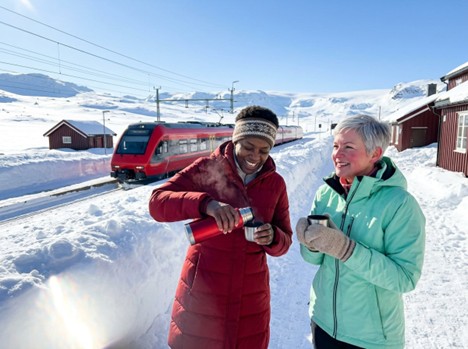
Great Value Vacations takes the top spot, and the reasoning has three parts that happen to line up with both a budget and a conscience.
The airfare is in the price. Of the twenty operators here, only Great Value Vacations, Exoticca, Gate 1 (as an option) and Expedia publish a number that includes the transatlantic flight. Nordic Visitor, Fjord Tours, Up Norway, 50 Degrees North, Go Ahead, Globus, Trafalgar, Collette, Tauck, Viking, Hurtigruten, Havila and Costco all exclude it. So when you see Globus at $4,799 and Great Value Vacations at $2,845, those are not comparable numbers.
There is no rental car in any of their five packages. Not one. Everything moves by train, scenic bus and fjord boat. I went looking for a car-rental line item and there isn’t one. For the exact corridor they sell — Oslo to Flåm to Bergen — a car is genuinely unnecessary, and the train is electrified and the fjord boats are electric or hybrid. That’s the lowest-impact way to see the fjords that doesn’t involve not going.
They fly you into Oslo and out of Bergen. An open-jaw, so you cross the country once instead of backtracking. Fewer miles, one less travel day.
Here’s what you get:
- The cheapest way in is $1,303 — Affordable Copenhagen, Oslo & Stockholm, three Scandinavian capitals over 6+ nights, with air and the two short flights between cities. Note this one is bare: no tours, transfers or breakfast.
- The one I’d book is Vision of the Fjords, $2,845 from JFK. Six nights, Oslo to Flåm to Bergen. It’s fully escorted with a tour escort for the whole trip, includes the Flåm Railway both directions, a cruise on the Nærøyfjord — which is inside the UNESCO World Heritage area — dinner daily in Flåm, and daily breakfast. Winter departures only.
- Winter Wonders of the Fjords, $3,075, is the closest thing to the classic fjord route: Bergen Railway to Voss, scenic bus through Gudvangen to Flåm, a winter RIB fjord safari, a five-course Viking dinner, the panoramic Flåm Railway, then the Bergen Railway back to Oslo.
- Magic of the Fjords, $3,148 from Boston, adds Balestrand and a half-day glacier excursion at Fjærland, with two Sognefjord boat legs.
- Oslo Explorer, $1,638, is three or four nights in Oslo with a panorama tour and daily breakfast — the lowest-commitment version.
- Four of the five include daily breakfast, which in Norway is not a minor perk. More on that below.
- They display 4.7 out of 5 on the Norway page, though note it’s from only 40 reviews — a small sample, and I’d rather tell you that than quote it as if it were thousands.
| Sample GVV Norway Package | Nights | Starting From* | Highlights |
|---|---|---|---|
| Affordable Copenhagen, Oslo & Stockholm | 6+ | $1,303 | 3 capitals, air + inter-city flights. No tours, transfers or breakfast |
| Oslo Explorer | 3 or 4 | $1,638 | Air, 4-star hotel, Oslo panorama tour, daily breakfast, transfers |
| Vision of the Fjords ★ | 6 | $2,845 | Fully escorted. Flåm Railway both ways, Nærøyfjord cruise, dinner daily in Flåm, breakfast daily |
| Winter Wonders of the Fjords | 6 or 8 | $3,075 | Bergen Railway, RIB fjord safari, Viking dinner, Flåmsbana, breakfast daily |
| Magic of the Fjords | 6 or 8 | $3,148 | Adds Balestrand + Fjærland glacier excursion, 2 Sognefjord boat legs |
Two honest notes, because you’d want them. First, their package is named “Vision of the Fjords,” and there is a real boat called Vision of The Fjords — but that 2016 vessel is the hybrid, not one of the fully electric ones. The Nærøyfjord sailing is normally run by Future of The Fjords, which is fully electric. So the accurate thing to say is “an electric fjord cruise,” and if the specific vessel matters to you, confirm at booking. Second, there’s also a sixth package — The Norwegian Fjords & Historic Capitals, 6 nights from $1,699 — that’s currently marked sold out, so don’t plan around it. And as of mid-October 2026 there was no Norway-specific sale running, though Ireland, Malta and Tuscany all had one.
🌿 My verdict: The only operator combining airfare, hotels, the Flåm and Bergen railways, a fjord cruise and daily breakfast under $3,000 a person — with no rental car anywhere in the itinerary. Browse current Norway packages →
2. 50 Degrees North: Best Sustainability Credentials
I’m putting this at number two rather than burying it, because for this blog’s readers it may genuinely be the right answer.
50 Degrees North is a certified B Corporation, publishes carbon labelling on selected tours, works with eco-certified partners, and gives 10% of annual profits to its own impact fund. Of everyone on this list, they’re the operator whose environmental claims came with the most actual substance behind them. Their published range is enormous: Highlights of Norway 4 days from $1,074, Norway by Rail & Sea 7 days $2,198, Norway’s Classic Fjords 6 days $2,514, Norway In-Depth 17 days $10,254. Best for: travelers for whom certification is the deciding factor. Watch out for: land only, so add your flights — which is the honest reason they’re at #2 and not #1.
3. Exoticca: Deep-Discount Air-Inclusive
Exoticca includes flights and runs very aggressive promotions. Nordic Paradise: Fjords & Railway, 8 days, $2,399. Norway Full Circle is 13 days from $4,049, cut 50% from $8,099, with the Flåm Railway, a Nærøyfjord and Aurlandsfjord sailing, three ferries, 11 breakfasts and 2 dinners. Best for: the longest air-inclusive itinerary for the money. Watch out for: fast-growing online brand, so read reviews on the specific trip.
4. Fjord Tours: The DIY Benchmark
This is the official operator of Norway in a Nutshell® — the trademarked route everyone else imitates. And it’s remarkably cheap because it’s just the tickets: the one-day version is about $283 (NOK 2,698), using the Bergen Railway, the Flåm Railway and a Nærøyfjord cruise. Longer versions: Sognefjord Cruise & Balestrand 3 days ~$994, Cities & Coastal Cruise 4+ days ~$1,252. They state their tours use electric buses. Best for: confident planners who want the famous route without a package markup. Watch out for: land only, and you’re booking your own flights and hotels around it.
5. Nordic Visitor: Best-Planned Self-Drive
If you do want a car, Nordic Visitor does self-drive better than anyone — detailed day-by-day itineraries, a personal consultant, car with unlimited mileage and insurance, hotels, breakfast, a marked map and a 24/7 helpline. 5 Day Bergen & Fjords from $1,562, up to 17 days at $6,438. Best for: travelers who want to reach the places trains don’t. Watch out for: land only, and they say so plainly — they’d rather you book flights direct to use miles.
6. Gate 1 Travel: Cheapest Escorted With an Air Option
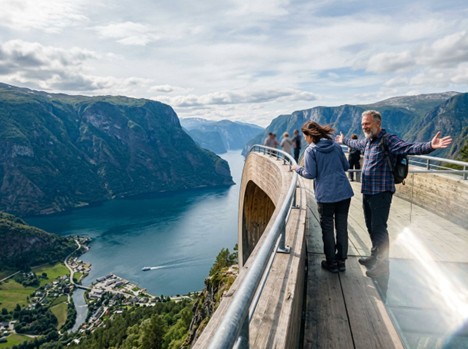
Gate 1’s 8 Day Classic Norway for 2027 is $2,899 land-only or $3,749 with airfare, departing Thursdays from May 6 to September 23, 2027, with a $700 single supplement. It includes the Flåm Railway and a Sognefjord cruise. Best for: travelers who want a proper guided tour and one price. Watch out for: larger groups, and read which version you’re buying.
7. Expedia (Flight + Hotel): Best for Total DIY Control
Bundles your exact flight and hotel. Best for: flexibility. Watch out for: I found Expedia advertising Norway “from” five different numbers across five of their own pages, none of them consistent, and the page I checked surfaced hotels in Kansas. Treat any headline price there as decoration and get a real quote.
8. Hurtigruten: The Iconic Coastal Voyage
The working coastal ship that’s been running the Norwegian coast for generations — 34 ports each way, full board on all voyages. Bergen to Kirkenes and back is 12 days from $2,155 (reduced from $3,079); the 6-day southbound leg is $1,179. Their fleet retrofit cut CO₂ by 25% and NOx by 80%, with three ships converting to hybrid. It enters Geirangerfjord late May to early August. Best for: slow travel, and seeing places no road reaches. Watch out for: no airfare, excursions cost extra, and their own page doesn’t state which year’s pricing you’re looking at.
9. Havila Voyages: The Greener Coastal Alternative
Havila runs the same coastal route with four LNG-and-battery ships that emit about 35% less CO₂ than conventional vessels and can sail emission-free for up to four hours. They’re targeting full biogas by 2028 and zero emissions by 2030. Best for: the coastal voyage with better numbers behind it. Watch out for: their voyages page shows “from per person” with no actual amount — I couldn’t get a price. And their own marketing leans on “eco-friendly” without publishing the figures, which is frustrating given they have good ones.
10. Authentic Scandinavia: Oslo-Based Self-Guided Rail
A local operator running the self-guided equivalent of the famous route — their Oslo, Bergen & Fjord Experience includes the Flåm Railway, a Nærøyfjord cruise and hotels with breakfast, with add-ons to Tromsø or onward to Stockholm and Helsinki. Best for: dealing with a company actually based in Norway. Watch out for: no published prices, so it’s a quote.
11. Intrepid Travel: Small-Group Active Travel
A certified B Corp with genuine small groups. A Taste of Scandinavia, 7 days, $2,745 (from $3,660); Norway: Hike, Bike & Kayak 7 days $3,495; and a Norway Family Holiday with Teenagers, 6 days, $4,320. Their trips support the Intrepid Foundation. Best for: active families and solo travelers. Watch out for: land only, and I couldn’t find per-trip carbon labelling despite the B Corp status.
12. Trafalgar: Mainstream Guided Coach
Best of Norway, 9 days, $3,465 on sale for a May 2027 departure. Ten stops including Geiranger and Hardangerfjord. Best for: travelers who want everything handled. Watch out for: land only, and notably no Flåm Railway and no specified fjord cruise — which for a fjord trip is a real gap.
13. Viking: Adults-Only Ocean Cruising
Viking Shores & Fjords, Amsterdam to Bergen, 8 days from $4,299, calling at Oslo, Stavanger, Flåm and Bergen. One complimentary excursion per port, all meals, wine and beer at lunch and dinner, Wi-Fi and port taxes included. Best for: unpacking once. Watch out for: cruise-only pricing, adults only, and a cruise gives you an afternoon ashore rather than days.
14. EF Go Ahead Tours: Most Thorough Itinerary
Their Fjords of Norway runs 12 days (16 with the Lofoten and Oslo extension) and includes both the Bergen Railway and the Flåm Railway, a RIB fjord safari, a Geirangerfjord cruise, an on-tour flight and two ferries. 2027 prices run $4,999 to $5,979 — and the June 16–27 and August 4–15 departures are already waitlisted, which tells you something about 2027 demand. Best for: seeing the most. Watch out for: prices are explicitly “before flights.”
15. Globus: Polished Premium Escorted
Scenic Norway, 10 days, from $4,799 for a May 2027 departure, with a Nærøyfjord cruise, Hardangervidda and the Loen Skylift. Best for: classic, reliable touring. Watch out for: land only, and no Flåm or Bergen Railway.
16. Up Norway: High-End Bespoke
An Oslo-based curator building fully tailored trips — private Roseslottet tours with the artist, Oslofjord road-bike rides, sustainable-architecture tours. Best for: a one-of-a-kind itinerary. Watch out for: no published prices anywhere, and while they describe a “sustainable approach,” I couldn’t find a named certification behind it.
17. Discover Norway: Self-Guided Hiking and Biking
A Norwegian specialist in self-guided active trips — hiking, cycling, skiing. Best for: families who’d rather walk it than ride a coach. Watch out for: I couldn’t retrieve any pricing at all, so treat this as a lead to follow rather than a recommendation.
18. Tauck: All-Inclusive Small-Ship Luxury
Tauck’s Norwegian Fjords & Coastal Treasures was showing “Prices coming soon” when I checked, with a $1,500 per-person deposit. Airport transfers included; airfare explicitly not. Best for: the top-end splurge. Watch out for: no price published yet.
19. Collette: Established Escorted Brand
Collette’s Highlights of Norway page rendered completely empty for me — no days, no price, no itinerary. They’re a reputable long-standing operator and they do sell air-inclusive options, so this is a “call them” rather than a “skip them.”
20. Costco Travel: Member Shop Card
Norway appears at Costco only as an Adventures by Disney trip, with no days and no price displayed, plus cruise listings from Celebrity, Holland America and Cunard. Their page states plainly that airfare is not included in land package prices. The upside is up to a $2,000 Costco Shop Card. Best for: members buying a cruise anyway. Watch out for: there’s no Costco-direct Norway land package to buy.
Now the Sustainability Part — With the Numbers
This is the section I actually wanted to write, and I’ve split it into “what holds up” and “what doesn’t,” because both matter.
What Holds Up
The ferries are real. Norway had 111 electric car and passenger ferries in service as of August 2026. MF Ampere — the world’s first fully electric car ferry — has crossed the Sognefjord since 2015 and marked ten years of service in February 2025. MS Medstraum, the world’s first fully electric high-speed ferry, cuts about 1,500 metric tons of CO₂ a year and uses roughly 30% less energy than the alternative. Norway is now deploying what’s described as the world’s largest fleet of hydrofoiling electric ferries.
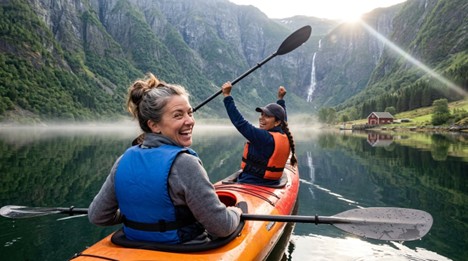
The fjord cruise is genuinely electric. The Flåm–Gudvangen route runs 36 km in about two hours through Aurlandsfjord and then Nærøyfjord, and about half the route is inside the UNESCO World Heritage area. Legacy of The Fjords carries an 1,800 kWh battery, charges in under 20 minutes, and is credited with cutting up to 700 tonnes of CO₂ a year on that route. Future of The Fjords was the world’s first all-electric carbon-fibre passenger catamaran.
The UNESCO status is real and specific. “West Norwegian Fjords – Geirangerfjord and Nærøyfjord,” inscribed in 2005, 122,712 hectares.
The grid is real. Norway produced a record 157.2 TWh in 2024, with hydropower at about 88% of normal annual production and wind adding 15.9 TWh. The official source doesn’t publish a single renewable-share figure; third parties commonly say ~98%, which is a reasonable approximation rather than an official number.
The EV figure is extraordinary. 98.7% of new car sales in August 2026 were battery-electric, 97.8% year-to-date, achieved despite subsidy cuts. One honest caveat: that’s new-car sales share, not the share of cars on the road.
The train is genuinely low-carbon. The Bergen Line opened in 1909 and has been fully electrified since December 1964. The Flåm Line was built with electric traction from the start — 20 km, a 5.5% gradient, 864 metres of descent. Electrified track on a grid that’s ~88% hydro means the Oslo–Bergen journey is about as clean as long-distance travel gets.
There’s a certification scheme with teeth. Innovation Norway’s “Sustainable Destination” label, established 2013, holds GSTC-Recognized status, is re-evaluated every three years, and requires documented improvement to retain. Almost 50 destinations hold it — and Bergen, Geirangerfjord, the Sognefjord area and Voss are all certified, which means the exact corridor these packages sell runs through certified destinations. Visit Norway is also careful to say the label doesn’t mean a place is fully sustainable, only that it’s measurably improving. I appreciate that honesty.
What Doesn’t Hold Up
I’d rather you heard this from me than found it out later.
The big one: Norway’s economy runs on exporting fossil fuels. Oil, condensate, NGL and gas exports came to roughly NOK 1,000 billion in 2025 — about 57% of Norway’s total goods exports. Norway is the world’s fourth-largest gas exporter, and its 2025 gas exports exceeded 30% of total EU and UK gas consumption. Essentially all of it is exported. One advocacy group puts Norway’s oil and gas exports at around ten times its domestic emissions. So: a country decarbonizing its own footprint beautifully while funding much of that by selling the fuel other countries burn. Domestic virtue, exported emissions. That tension is real and I don’t think a sustainability-minded reader should be handed the fjord story without it.
The “cruise ships banned from the fjords” headline is wrong. You’ll see this claim a lot. What actually happened: a 2018 parliamentary decision would have barred non-zero-emission cruise ships from the World Heritage fjords by 2026. In August 2024 the government delayed the large-ship requirement by six years, to 2032, splitting the rule by vessel size. So as enacted: from January 1, 2026, passenger ships under 10,000 gross tonnage in Geirangerfjord and Nærøyfjord must use energy sources emitting no CO₂ or methane in use. Ships of 10,000 GT and above have until January 1, 2032. Because even small cruise ships usually exceed 10,000 GT, the 2026 rule in practice binds ferries and sightseeing boats, not the big cruise ships. Biogas remains a permitted compliance route even after 2032. Havila’s CEO publicly called the revision a “scandal,” arguing biogas is climate-neutral, not zero-emission. He has a point.
The flight is the whole ballgame. A round-trip transatlantic flight is far and away the largest part of a US family’s Norway footprint — bigger than anything you save by picking an electric boat over a diesel one. The levers that actually matter are trip length and frequency (one longer trip instead of two short ones) and choosing rail over internal flights and rental cars once you’re there. Which, conveniently, is also the cheaper and calmer way to do it.
Overtourism in the fjords is real. Geiranger receives roughly 800,000 visitors a year, two in five of them cruise passengers. The Norwegian Maritime Authority has warned that air quality in the narrow fjord will at times be hazardous. Norwegian cruise ships burn around 170 million litres of fuel a year — nearly 3% of national greenhouse emissions — of which about 20% is burned in port. That’s the strongest argument I found for taking the train and the small electric boat instead of the big ship.
And some “eco” marketing is just marketing. Havila’s own page says “modern, eco-friendly” with no figures. Hurtigruten’s Coastal Express page carries a sustainability link and a “Made in Norway” badge but no emissions numbers and no mention of its hybrid ships. Hurtigruten’s much-publicized Sea Zero — 60 MWh battery, retractable wind and solar sails — is a concept, not a ship you can book. The verifiable numbers sit with the smaller operators.
Let’s Talk About the Money, Because Norway Is Expensive
I’m not going to pretend otherwise. Here are Visit Norway’s own figures, with dollars at about 9.53 krone (October 2026):
| Item | NOK | ≈ USD |
|---|---|---|
| Cappuccino at a coffee bar | 35–65 | $3.70–6.80 |
| Meal in a budget restaurant | 190–350 | $20–37 |
| Three-course mid-range dinner | 650–1,500 | $68–157 |
| Beer from a grocery shop | 35–50 | $3.70–5.25 |
| Beer in a bar | 100–140 | $10.50–14.70 |
| Oslo food-hall lunch | 140–220 | $15–23 |
| Supermarket breakfast per person | 60–90 | $6.30–9.44 |
| 1 litre of milk | 20–25 | $2.10–2.60 |
The strategy that actually works: a package with daily breakfast included (four of the five GVV ones have it), food halls and supermarket lunches rather than restaurant lunches, and accepting that alcohol is the single biggest multiplier — a bar pint costs roughly three times a supermarket can. A packed lunch and a thermos is completely normal in Norway, not a sign you’re economizing. That’s the difference between a $40-a-head lunch and a $15 one, every day.
Cards work almost everywhere, Apple and Google Pay included. Visa and Mastercard are widely taken; Amex and Diners much less so — ask first. Some post offices and grocery shops won’t take foreign credit cards but will take debit. Tipping is generally not expected.
Getting There Is Harder Than It Was
This is the most important practical change for 2027, and it argues for booking early.
As of October 2026 there are only two nonstop US–Oslo routes, and SAS operates both — Newark–Oslo about 3–4 times a week and JFK–Oslo twice weekly, on A321neos, roughly 7 hours 35 minutes. Chicago, Atlanta and Los Angeles are connection-only.
Norse Atlantic has effectively exited the US–Norway market. They dropped Los Angeles entirely and removed Fort Lauderdale, Miami, Las Vegas and Boston. Their JFK services end October 25, 2026 with no New York flying until at least March 27, 2027, and the aircraft are going to winter Thailand routes. There was no press release — the routes just disappeared from booking systems. A summer 2027 return is possible but unannounced.
So nonstop capacity to Oslo has shrunk heading into 2027, and it’s now essentially a single-carrier market. Fare volatility on the Newark route has been severe — monthly figures ranging from $438 in January to $2,150 in May. That’s the single best argument in this entire post for buying a bundle where somebody else has already locked the seat, rather than booking piecemeal and hoping.
9 Smart Tips Before You Book
- Always compare “with airfare” against “land only.” Fourteen of the twenty operators here exclude it.
- Book a package with daily breakfast. In Norway this is a meaningful line item, not a perk.
- Skip the rental car for the Oslo–Flåm–Bergen corridor. Train, bus and boat genuinely cover it, parking in the cities is expensive, and tolls are billed automatically after the fact. Lofoten and the deep side-valleys do want a car — be honest with yourself about which trip you’re taking.
- Go in shoulder season. The classic fjord products are summer-weighted — Sognefjord in a Nutshell runs April to October, Geirangerfjord June to September — but May and September give you the scenery with fewer ships.
- For northern lights, think September–April, with March–April and September–October statistically strongest. Tromsø’s midnight sun runs mid-May to late July; polar night is late November to mid-January. Sightings are never guaranteed.
- Buy wine and beer at a grocery store or Vinmonopolet, not a bar. Roughly a third of the price.
- Take the family carriage on the Bergen Line. Vy runs one on the Oslo–Bergen route free of charge for passengers travelling with children — a playroom for ages 0–7, adjoining seating, stroller space and changing tables. You need a Lowfare, Flex or Flex Refundable ticket and you must tick the “Family” box when booking. It’s not on the first departure from Bergen or the ~14:30 from Oslo.
- Build buffer at your first European border for EES biometrics.
- Book 2027 early. Go Ahead’s June and August 2027 fjord departures are already waitlisted, SAS is the only nonstop carrier, and Tromsø’s levy starts January 1.
Norway FAQs
Do I need ETIAS for a 2027 trip?
Not right now. Norway is in Schengen so ETIAS will apply once it exists, but it has not launched and the EU has not announced a date — the late-2026 target was removed from the official portal in July 2026. The fee will be €20 and it’ll last three years. Some tourism pages still show old dates; check the official EU portal close to departure.
Is Norway doable on a normal budget?
Yes, with structure. A package with airfare and daily breakfast included, food-hall and supermarket meals, trains instead of a car, and treating alcohol as an occasional thing rather than a nightly one. Without that structure, Norway will absolutely eat a budget.
How many days do I need?
Six nights covers Oslo–Flåm–Bergen properly and that’s what most packages are built around. Three or four nights works for Oslo alone. Lofoten or the far north really wants 10 or more.
Is this a good trip with kids?
The fjord corridor is, yes — trains, boats, short distances, and a free family carriage on the Bergen Line. Of the GVV packages, Winter Wonders (RIB safari, Viking dinner) and Oslo Explorer (short, one hotel) are the most workable. Exact child train fares I could not pin down reliably — Vy’s bus rule is that children five and under pay 10% of the adult fare, but I couldn’t confirm the train equivalent, so check vy.no before you budget.
What’s the single most sustainable choice I can make here?
Honestly? Go once and stay longer, rather than twice and shorter — the flight dominates everything else. Then take the train instead of internal flights, skip the rental car on the main corridor, and if you’re choosing between a big cruise ship and a small electric fjord boat, the small boat isn’t close.
Wherever you land, the moves are the same: compare with-airfare against land-only, book breakfast in, take the train, and don’t let anyone sell you “eco-friendly” without a number attached. If you want the easiest place to start, Great Value Vacations bundles the flights, the hotels, the railways and the fjord cruise with no car anywhere in the itinerary — and if certification is your deciding factor, 50 Degrees North is the B Corp worth a second look.
More from the blog:
🌿 Browse all of my travel and simple-living posts
https://www.ahappyhippymom.com/2026/08/how-to-plan-a-more-sustainable-family-vacation.html
All images credited to the Responsival Design Team














Leave a Reply